


The growing availability of data across scientific domains has opened new opportunities for research, but it has also introduced significant challenges when dealing with sensitive information. Fields such as healthcare, demography, or social sciences rely on datasets that often contain personal or confidential details. Ensuring that this data can be safely used without compromising individual privacy is therefore a critical requirement. This is where data anonymization becomes essential.
Data anonymization refers to the process of transforming datasets in such a way that individuals can no longer be identified, either directly or indirectly. This goes beyond simply removing obvious identifiers such as names or email addresses. It also involves modifying or generalizing certain attributes and applying statistical techniques to reduce the risk of re-identification. The challenge lies in maintaining a balance: data must remain useful for analysis while ensuring that privacy is fully protected.
In particular, we have focused on sensitive tabular data anonymization. Then, let’s briefly define four key concepts about the attributes or columns of a database. Firstly, the identifiers are those variables in a database that allow to identify an individual (e.g. name, ID number, email…). On the other hand, the quasi-identifiers (QI) are variables that although a priori seem not to show relevant information, combined between them can make possible the identification of an individual, as occurs in the case of the U.S. Census. Moreover, they are accessible to the attacker (e.g. gender, age, city, etc.). Finally, we have the sensitive attributes (SA), which are the columns of the database that contain sensitive information that must not be disclosed and must not be able to be extracted [1].
In this lines, one of the main milestones of EOSC SIESTA involves the development of two open-source anonymization tools, such as anjana and pyCANON, which allow researchers to both apply anonymization techniques and assess the parameters associated with the supported anonymization techniques. Specifically, the following techniques are available in both anjana and pyCANON:
- k-anonymity
- (α,k)-anonymity.
- ℓ-diversity.
- Entropy ℓ-diversity.
- Recursive (c,ℓ)-diversity.
- t-closeness.
- Basic β-likeness.
- Enhanced β-likeness.
- δ-disclosure privacy.
The idea of these techniques is to remove the identifiers and apply recursive transformations on the quasi-identifiers that allow them to be generalized, making complicated to extract information about a particular individual [2].
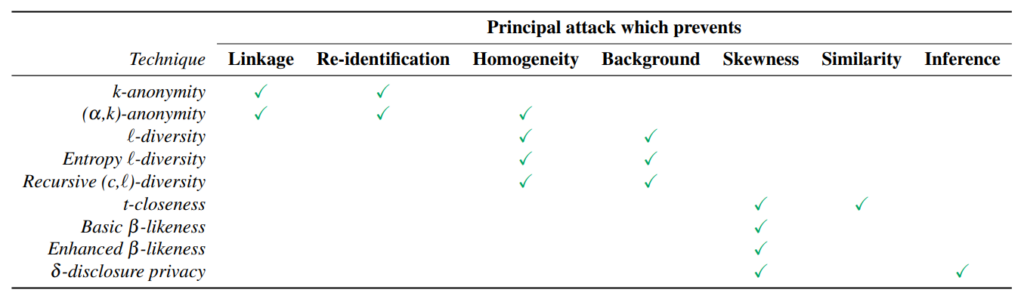
The combination of these techniques is particularly important, as each one helps prevent various types of privacy and data security breaches, as shown in the following table:
Within the scope of the EOSC SIESTA project, complementary strategies such as the generation of synthetic datasets and the evaluation of FAIR principles for sensitive data, further expand the possibilities for safe and effective data use, enabling scientists to extract value from sensitive data while ensuring that privacy and trust remain at the core of the process.