


Federated learning is an approach to training artificial intelligence models that allows multiple participants to collaborate without sharing their data directly. Instead of sending datasets to a central location, each participant keeps their data locally and trains a model within their own environment. Only the resulting model updates are shared with a central server, which aggregates them to improve a global model. This approach is particularly valuable in contexts where data are sensitive, such as healthcare, industry or social sciences, where privacy and confidentiality must be preserved.
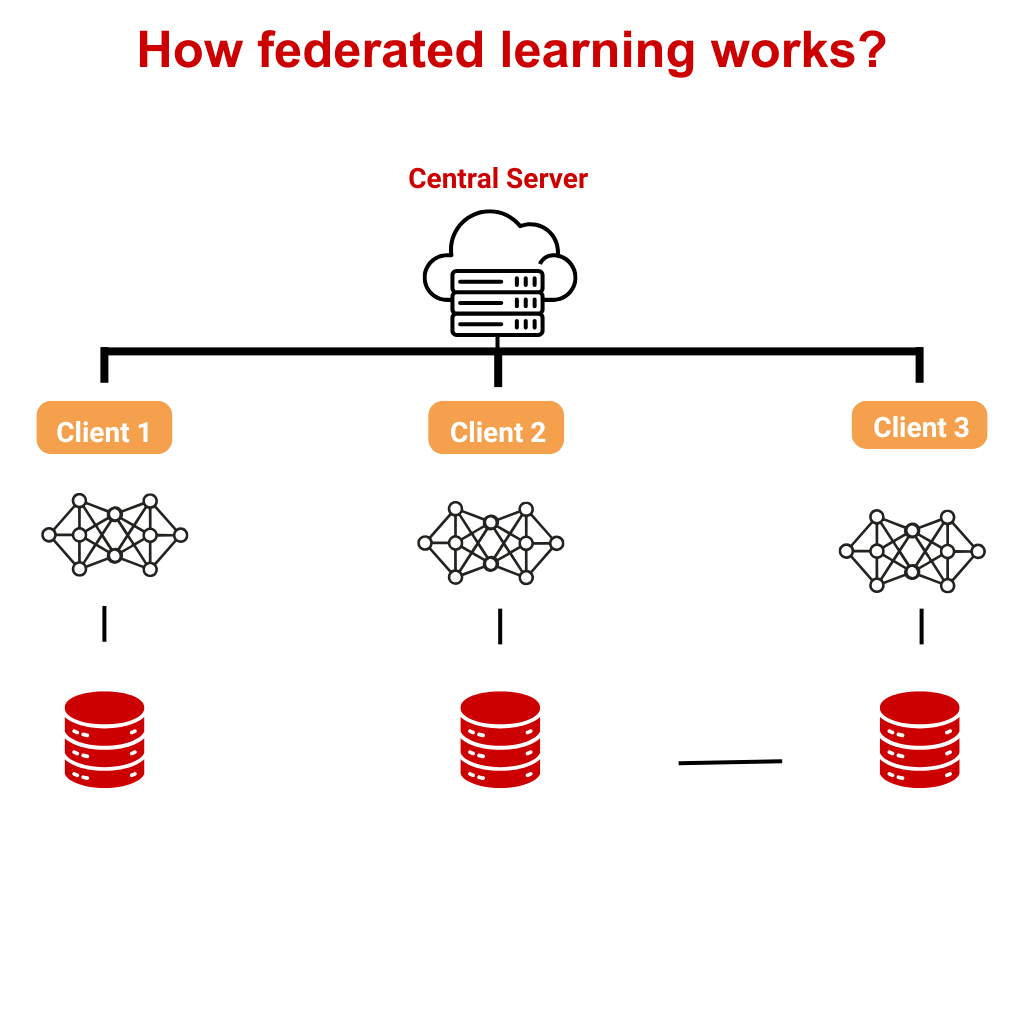
The standard architecture of horizontal federated learning (hereinafter referred simply as FL) is as follows [1]:
- SERVER: creates the model to be trained locally by each client.To do this Python libraries tensorflow, keras, PyTorch, sklearn, etc, can be used
- SERVER: transmits the model to the clients.
- CLIENT: each of them trains the model with its local data.
- CLIENT: each of them sends the local parameters (or the model updates) to the server. Here it is important to note that in raw data is not transmitted. However, model/parameters sharing this must be done in an encrypted form, as information about the data could be extracted from it.
- SERVER: aggregates the weights of each client using an aggregation strategy and updates the model.
- Repeats the process from step 2.
In this context, EOSC SIESTA introduces a new federated learning client service that enables users to easily participate in this distributed training process. Through the SIESTA dashboard, users can create and configure their own federated learning clients by uploading their data and models, and managing them within a secure environment. Data can be stored and accessed through integrated S3 storage, ensuring that all information remains under the control of each user or institution.
The connection between EOSC SIESTA and AI4EOSC is key to enabling this functionality. While EOSC SIESTA provides the environment where users deploy and manage their local clients, AI4EOSC hosts the federated learning server responsible for coordinating the training process. Using the Flower framework and secure communication protocols such as gRPC, clients created in SIESTA can automatically connect to the server deployed in AI4EOSC.
This integration allows multiple institutions to collaboratively train AI models without exchanging sensitive data, combining the strengths of both platforms. EOSC SIESTA ensures secure data handling and user friendly client deployment, while AI4EOSC provides the infrastructure needed to orchestrate and aggregate the distributed training process. Together, they enable a practical and privacy aware implementation of federated learning within the EOSC ecosystem.