


EOSC-SIESTA aims to provide a set of tools, services and methodologies for the effective sharing of sensitive data, following a cloud-based model in the European Open Science Cloud. In this context, the SIESTA Dashboard plays a key role by bringing together the main components of the platform and making them accessible through a single interface.
The EOSC-SIESTA Dashboard is the main interface through which users can access the different services and tools developed within the project. It has been conceived as a central entry point to simplify the use of the platform and support secure workflows for working with sensitive data.
This interface provides the necessary integration layer to align the EOSC-SIESTA technical capabilities with its strategic use cases. It supports the deployment and access to services developed within the project, helping users test tools, manage data-related workflows and explore solutions adapted to different scientific domains.
The Dashboard includes a Service Catalog organized by functionality. Each section brings together the specific features associated with particular research needs, allowing users to identify and access the resources that are most relevant to their domain.
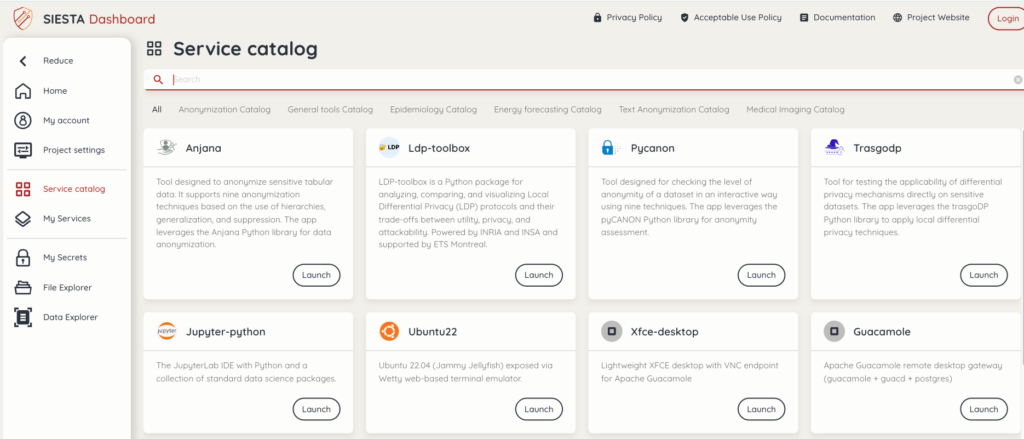
From an infrastructure perspective, the Dashboard is a Helm interface based on Onyxia, providing access to the services deployed within the platform. It also integrates an S3-compatible object storage service, powered by MinIO, where users can store the datasets and files they want to work with. This storage component enables users to manage files directly within the platform and integrate persistent storage into the services available through EOSC-SIESTA.
This entire technical setup was explored in greater depth during the 3rd EOSC-SIESTA Webinar: “A journey through the SIESTA computing infrastructure.” The session provided a detailed look at these core computing components, showcasing the process for deploying a service catalog through pipelines, as well as the security hardening measures implemented within the cluster.
The S3 storage can be accessed in several ways depending on users needs. A dedicated File Explorer is available in the Dashboard interface, allowing users to upload and download files directly from the browser. In services where this feature is enabled, the storage can also be mounted as a volume, making stored data available inside the running environment. In addition, S3 credentials are provided in the My Account section, enabling manual access from external environments, scripts, or applications compatible with the S3 API.

Secrets in the SIESTA Dashboard work as protected variables, allowing users to store sensitive information, such as passwords, tokens, or private configurations, so they can be safely injected into a running service without being exposed in the source code.
To support users in becoming familiar with the platform, the EOSC-SIESTA infrastructure team has prepared a tutorial explaining the Dashboard interface, its main sections and the different elements available through it.
The EOSC-SIESTA Dashboard will continue to evolve as new services, tools and resources are integrated into the platform. Its development represents a significant step towards making secure and privacy-preserving data analysis more accessible for research communities working with sensitive information.