


In medical environments, data is the basis of all research, but much of this data contains personal or even sensitive information, which means it cannot be freely shared without considering the privacy of research participants. The purpose of EOSC-SIESTA is to create different tools for researchers to work with sensitive data without compromising the privacy of research participants or the confidentiality of the information.
The medical imaging use case in EOSC‑SIESTA focuses on the secure reuse of sensitive data, primarily neuroimaging. The team develops a framework where researchers who are responsible for the acquisition and curation of medical imaging data can share it with others who can use the data to answer research questions.
Without disclosing the full sensitive data to the data users, it is hard to know the details of the data that are required to implement the data analyses. To address this, the medical imaging team implemented methods and tools that allow scrambling the original raw data.
By scrambling, data rights holders transform tabular and neuroimaging data in BIDS-formatted datasets into pseudorandom, or “scrambled,” versions. These versions preserve the global organization and overall structure of the data while removing personal and identifiable information.
The scrambled data is anonymous and can be shared with the data user, who can explore in detail the organization and content of the data and implement an analysis. The analysis scripts or computational container can be shared with the data rights holder who can apply it to the original non-shared data, and the results of the computation can be shared with the data user. The sharing of the scrambled data thereby facilitates federated analyses, where the original data is not disclosed. This allows private imaging data to be reused safely for scientific purposes while preserving privacy and confidentiality.
BIDScramble is being developed at the Donders Institute of the Radboud University in Nijmegen, NL. It generates scrambled or pseudo-random BIDS datasets from existing BIDS-structured data. It preserves the statistical distributions of user-specified variables, enabling details of the data content and organization to be shared.
The shared scrambled dataset allows researchers to explore, prototype, and evaluate their analysis pipelines on the anonymized yet realistic datasets. Because the scrambled datasets maintain the original organization and some statistical characteristics, the behavior of pipelines closely mirrors that on real data, accelerating development while protecting privacy.
Tutorials
The medical imaging team has prepared several concrete examples using previously shared non-sensitive, non-personal data to illustrate and test how the various use cases of the SIESTA platform work. These examples allow users to follow the steps of the process both from the perspective of the data acquisition and curation team (the data rights holders) and from the perspective of the researchers that want to reuse the data (the data users). This allows experimenting with creating different scrambled versions, and to run analysis pipelines without compromising privacy, serving as practice material and a reference for understanding how the secure computing strategy will be applied to sensitive medical data.
Each example use case builds on its own dataset that was previously shared publicly. These datasets allow users to download the data, verify that it is organized according to the BIDS standard, generate scrambled versions by following the tutorial commands, and test the analysis pipelines.
The datasets span a range of different neuroimaging methodologies, ranging from tabular data, anatomical imaging, functional imaging, EEG and MEG. These not only differ in the type of data and their organization such as file formats, but also the research questions that can be addressed with each dataset are different.
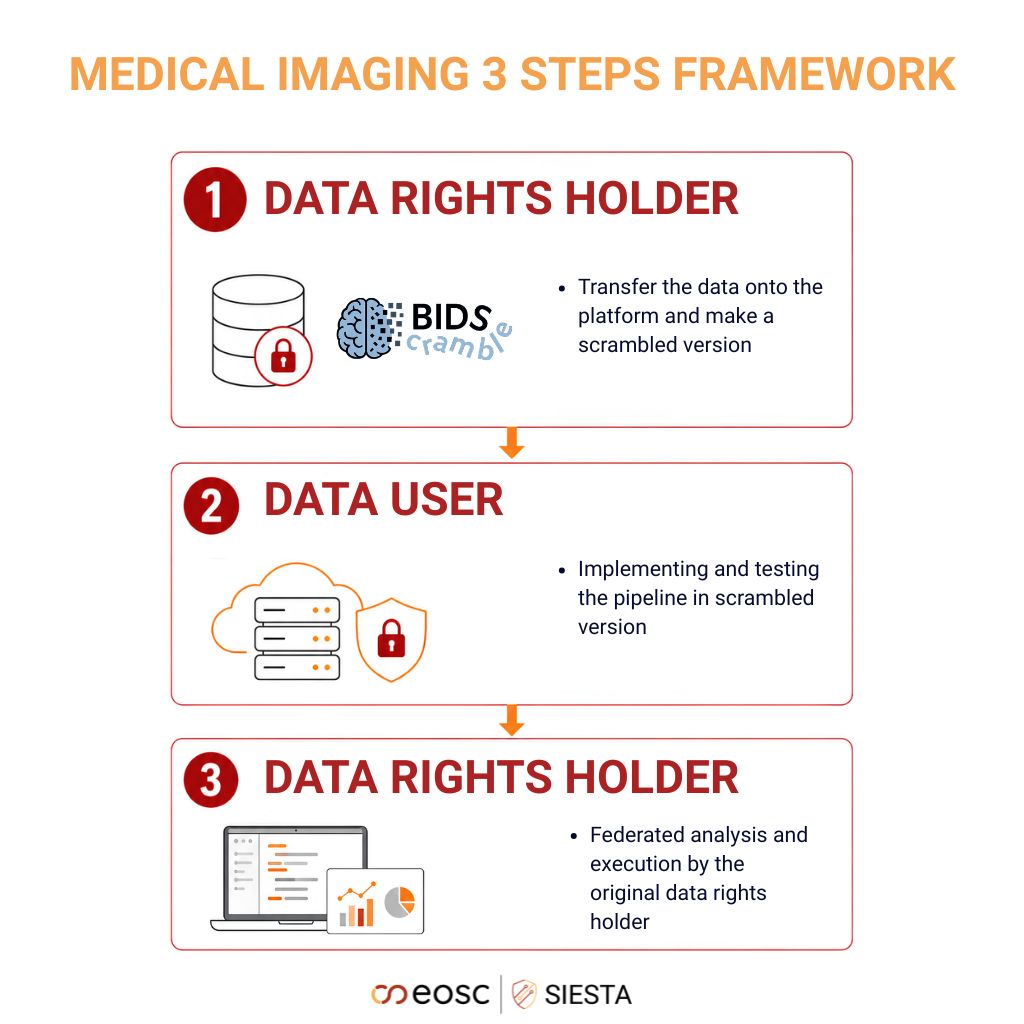
The examples follow three distinct steps. First, the data rights holder introduces the data in the SIESTA platform and makes a scrambled version, which is where BIDScramble comes into play. Then the data user implements and tests a pipeline on the scrambled version of the data. Finally, the data rights holder runs the differential private computation on the resampled version of the original data.
2.1 Use case – tabular data
This example uses an input dataset containing resting (eyes closed, eyes open) and cognitive (subtraction, music, memory) state EEG recordings with 60 participants during three experimental sessions together with sleep, emotion, mental health, and mind-wandering related measures. The data was acquired from 32 female and 28 male participants.
2.2 Use case – 3D medical images
This example is based on a dataset with brain scans from 136 young individuals with an age range from 18 to 35 years old, along with questionnaire-assessed measurements of trait-like chronotype, sleep quality and daytime sleepiness. The data was taken from 87 female and 49 male participants. The data is organized according to the BIDS standard and of interest for research in circadian rhythmicity, structural brain correlates of chronotypes in humans and the effects of sleeping habits and latitude on brain anatomy.
2.3 Use case – Time series
The dataset in this example is a multi-subject, multi-modal neuroimaging dataset. It includes structural and functional MRI, MEG, and EEG data that was recorded during an experimental task on face processing. The data was acquired from 7 female and 9 male participants. The example presented here focuses on the processing of the MEG.
2.4 Use case – Time series
This is an example with EEG data acquired during optimized cognitive paradigms. It contains data from 40 neurotypical adults, data processing pipelines and analysis scripts, and a broad set of results. The sample consisted of 25 female and 15 male participants.
2.5 Use case – 4D imaging space-time
In this fMRI example dataset, 44 subjects are divided into two experiments, with some participants taking part in Experiment 1, others in Experiment 2, and a few participating in both: 17 subjects underwent fMRIs dedicated to experiment 1, whereas 29 subjects underwent fMRIs dedicated to experiment 2. In this case, the participants consisted of 29 males and 16 females.
All datasets used in these 5 example use cases are already public and open access. The specific datasets for each use case are available in the corresponding repositories. Most data comes from OpenNeuro, one dataset comes from OSF.
BIDScramble is available for local installation and execution on the Windows, macOS or Linux computers of the data rights holders. Its code is open source and the documentation is available online. Additionally, users will be able to use the tool directly via the SIESTA Dashboard.